Quality Assurance System in Construction Sector

Introduction :
The objective of construction independent quality assurance is to independently assure that the activities of a specific project are being performed in accordance with all contractual specifications, codes and standards or government regulations. The QA/QC is verified through checks audits, inspections and witnessing. These audit services are carried out completely independently of the individual contractors, materials suppliers, manufacturer or sub-contractor as well as final user. Quality Assurance (QA) provides the facility owner with adequate confidence that a structure, component, material or system meets pre-stated quality standards and will perform satisfactory during service. Independent Quality Assurance (IQA) examines whether projects and programmers are on track for successful completion or whether action is required to prevent failure. It can improve the probability of successful project delivery and minimize the risk of cost and time blowouts. An IQA often provides very large returns by preventing costly project mistakes and delivering benefits earlier. An IQA is usually conducted on behalf of the project Sponsor or Executive to provide assurance that the project is appropriately planned, managed and controlled, and that the governance supports the project to best effect. All the quality paperwork in the world, with all their signatures, will not turn a poor-quality product into a good quality product. However, the paperwork trail is important in ensuring that proper quality procedures have been implemented and followed. The process of assuring quality by Independent Quality Assurance will further be improved by the implementation of ISO: 17020 as the overall system of quality system can be improved with the proper acceptance of the guidelines of the ISO: 17020. The requirements of ISO 17020 are contained mainly in 14 major sections including: (i) Administrative requirements, (ii) Requirements for independence, impartiality & integrity, (iii) Confidentiality, (iv) Organization & management, (v) Quality system, (vi) Personnel, (vii) Facilities & equipment, (viii) Inspection methods & procedures, (ix) Handling of inspection samples & items, (x) Control of records, (xi) Inspection reports & inspection certificates, (xii) Subcontracting, (xiii) Complaints & appeals
2.Aim of study:
The objective of the paper is to analyze the various factors that have a significant impact on effectiveness of quality and quality assurance system. The aim here is to put forward various key aspects and challenges encountered in achieving the quality in construction. The paper highlights the impact of implementation of ISO: 17020 in construction system which can contribute to overall up gradation in quality of projects.
3.Study analysis:
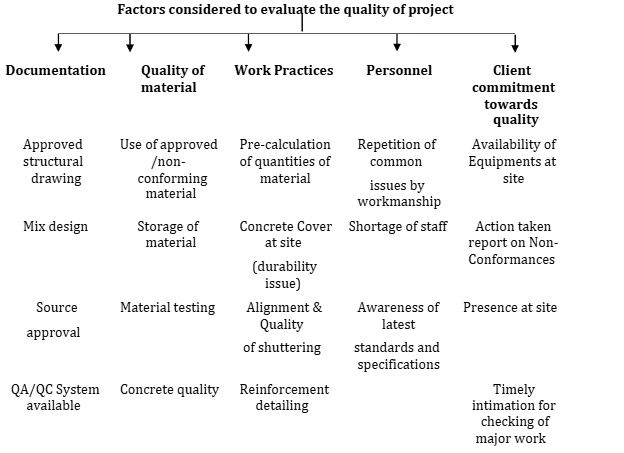
To analyze the quality of the different construction projects, National Council for Cement and Building Materials, India monitored 30 construction projects (15 before implementation of ISO: 17020 and 15 after implementation of ISO: 17020) were selected for Delhi and NCR with a construction cost between three to five Crores and data was collected from these projects on various quality and management related aspects. These 30 projects cover structures such as school buildings, community hall, hostel block, roads, drainage etc. The study was conducted for construction projects of four different government bodies. These projects were assessed for the quality assurance based on the factors playing key role in quality of a structure during construction such as documentation, quality of material, work practices, personnel and client commitment towards quality etc.